

Over 78% of UK households are now actively seeking chemical-free alternatives for their gardens, yet many still struggle with achieving that perfect green lawn without synthetic fertilisers and harsh pesticides. After transitioning my own 200-square-metre garden from chemical dependency to a thriving organic ecosystem, I can honestly say the results have been better than anything I achieved with expensive commercial products.
Here’s a little story about when a customers dog who became poorly after walking across his freshly treated lawn that the customer had been treating himself. That was his wake-up call – if it wasn’t safe for pets, what was it doing to his family and the environment? He contacted us for professional help as we only use products that are safe for people, animals and the environment.
Three years later, his lawn is lusher, more resilient, and costs a fraction of what he used to spend on chemical products, plus his dog is ok and enjoys laying on the lawn.
I’ll be honest, the first year was tough going all organic. My lawn looked decidedly average compared to the chemically-enhanced perfection of some other lawns. But by year two and lost of research and trial and error, something magical happened – my grass stayed green during the 2018 drought whilst chemical-dependent lawns turned brown. The improved soil structure and microbiology I’d been building was finally paying dividends.
British lawns face unique challenges that make organic methods particularly suitable. Our clay-heavy soils, unpredictable weather, and shorter growing seasons actually respond brilliantly to natural approaches that build soil health rather than providing quick chemical fixes. The secret lies in working with nature, not against it!
Why Choose Organic Lawn Care for UK Gardens?
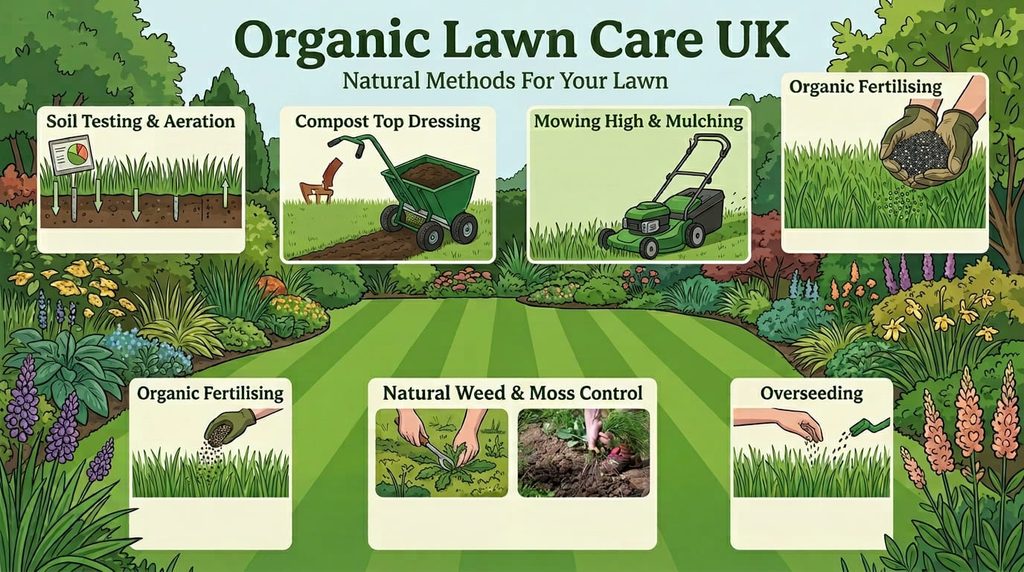
Making the switch to organic lawn care was one of the best decisions I’ve made for my lawn, though I wish someone had explained the real benefits beforehand rather than just the environmental stuff everyone bangs on about.
The cost savings are absolutely mental once you get past the initial learning curve. I used to spend about £300 annually on chemical feeds, moss killers, weed treatments, and all the paraphernalia that goes with synthetic lawn care. Now? its considerably less a year on organic amendments and the occasional bags of decent organic compost. Over five years, it’s saved me over £1,000 – enough for a decent weekend away!
But here’s what really sold me on organic methods: resilience. During that horrific drought in 2018, I watched people frantically watering their chemically-dependent lawns twice daily while mine sailed through with minimal intervention. The improved soil structure meant better water retention, and the diverse microbiology helped my grass access nutrients more efficiently.
The environmental benefits are obvious but worth mentioning because they directly affect your gardens ecosystem. Within six months of going organic, I noticed way more birds in my garden. Turns out they’d been avoiding the area when I was using synthetic treatments. Now I’ve got thrushes hunting for worms, hedgehogs visiting at night, and my kids can roll around on the grass without me worrying about what they might absorb through their skin.
UK weather patterns actually favour organic approaches. Our constant drizzle washes synthetic fertilisers away quickly, meaning you need repeated applications. Organic matter releases nutrients slowly and improves soil structure, so nutrients stick around longer. Plus, the improved drainage from better soil structure means less waterlogging during our inevitable wet spells.
Disease resistance improved dramatically after I switched. I used to get red thread fungi every autumn like clockwork. Now? Haven’t seen it in three years. Healthy soil biology creates natural lawn disease suppression that synthetic treatments simply can’t match. It’s like having an invisible army working for you underground.
The biggest surprise was how much easier maintenance became once everything established. No more precise timing of chemical applications, no more keeping kids and pets off the lawn after treatments, no more panic about rain washing away expensive products. Organic lawn care is much more forgiving and flexible.
Understanding Your UK Soil: The Foundation of Organic Lawn Care
I spent my first three years of lawn care completely ignoring my soil, treating it like dirt that held grass roots. Biggest mistake ever! Understanding your soil is absolutely fundamental to successful organic lawn care, and UK soils have some particular quirks that you need to work with.
Clay soil dominates much of the UK, and boy, did I learn about clay the hard way. My first attempt at organic lawn care failed spectacularly because I was trying to grow grass in what was essentially impermeable concrete. Clay particles are tiny and pack together tightly, creating drainage nightmares and making it hard for roots to penetrate.
The solution isn’t to fight clay – it’s to improve it gradually. I started adding organic matter wherever I could: compost, leaf mould, well-rotted manure. The trick is little and often rather than massive applications that just sit on the surface. After two years of regular organic matter additions, I can actually push my finger into soil that used to be rock-hard.
Soil testing revolutionised my approach when i was leaning, though I initially thought it was just for serious gardeners. Wrong! A basic soil pH test kit costs about £5 and tells you whether your soil is acidic or alkaline. Most UK soils tend toward acidic, which grass doesn’t love. Mine tested at pH 5.8 – no wonder my grass looked pale and struggled to establish.
Acidic soil locks up nutrients, making them unavailable to grass even if they’re present. I’ve seen people spend fortunes on organic feeds whilst their grass stays yellow because the soil pH is preventing uptake. Raising pH naturally takes time but transforms your lawn’s ability to access nutrients.
Drainage issues plague British lawns, especially in clay areas. I learned this during a particularly wet October when part of my lawn turned into a temporary pond. The solution involves improving soil structure through organic matter rather than expensive drainage systems. Earthworms become your best friends – they create natural drainage channels whilst processing organic matter.
Soil biology is where the magic happens, though it’s invisible so easy to ignore. Healthy soil contains millions of microorganisms that break down organic matter and make nutrients available to grass. Chemical treatments often damage this biology, which is why synthetic lawns need constant feeding – the natural nutrient cycling has been disrupted.
Building soil biology takes patience but delivers incredible results. I started by reducing disturbance (less digging and turning), adding organic matter regularly, and avoiding anything that might harm beneficial organisms. Within 18 months, the difference was remarkable – better drainage, improved nutrient availability, and grass that looked healthier than ever before.
Natural UK Grass Seed Selection and Establishment
Choosing the right grass seed for organic lawn care is completely different from conventional approaches, and I learned this through some expensive mistakes early on.
Most commercial grass seed mixtures are designed to work with synthetic fertilisers and chemical support systems. They often contain fast-growing varieties that look brilliant initially but struggle without constant chemical feeding. For organic systems, you want slower-growing, more resilient varieties that can thrive on natural nutrients.
Perennial ryegrass dominates UK seed mixes, and for good reason – it’s tough, establishes quickly, and handles our climate beautifully. But not all ryegrass is equal. I now look for varieties specifically bred for low-input systems rather than the fastest-growing options. They take longer to establish but create much more resilient lawns.
Fine fescues are absolute stars for organic lawns, though they’re often overlooked. They’re naturally drought-tolerant, grow slowly (less mowing!), and actually prefer lower nutrient conditions. Perfect for organic systems where you’re not pumping in synthetic nitrogen. My shady areas where ryegrass struggled have thrived since I overseeded with fine fescue.
Shade tolerance becomes crucial in typical UK gardens with mature trees and closely-packed houses. I made the mistake of trying to grow sun-loving grass varieties shaded by a massive trees, then wondering why they looked awful. Shade-tolerant fescues and some ryegrass varieties handle low-light conditions much better than standard mixes.
Overseeding organically requires different timing and techniques. I used to follow conventional advice about spring and autumn seeding, but organic establishment works better with soil temperature and moisture rather than lawn care calendar dates. My most successful overseeding happened in early October when soil was still warm but autumn rains were starting.
Soil preparation matters enormously for organic seed establishment. Rather than synthetic starter fertilisers, I create a gentle growing medium using compost and organic matter. The key is providing steady, slow-release nutrition rather than the quick hit that synthetic starters deliver. Seeds germinate more slowly but establish stronger root systems.
Watering organic seed requires a different approach too. Instead of frequent light watering that encourages shallow roots, I water deeply but less often once seedlings are established. This encourages the deep root growth that makes grass more drought-tolerant and better able to access natural soil nutrients.
Protection during establishment is crucial since you can’t rely on chemical fungicides if things go wrong. Good air circulation, avoiding overwatering, and choosing disease-resistant varieties help prevent the damping-off and other fungal issues that can devastate new seedlings.
Organic Feeding Methods Throughout the UK Growing Season
Feeding grass organically follows completely different principles from synthetic approaches, and getting this right was probably the biggest learning curve in my organic lawn care journey.
Spring feeding needs to be gentle and gradual rather than the massive nitrogen hit that synthetic feeds provide. I learned this after applying too much organic nitrogen early in my first organic year and creating soft, disease-prone growth that struggled through summer. Now I start with light applications of compost or worm castings in March, building up gradually as soil temperature rises.
The beauty of organic feeding is that soil biology does most of the work for you. Beneficial microorganisms break down organic matter and release nutrients at the rate grass can actually use them. No risk of burning or creating that artificial blue-green colour that screams “chemical lawn” from across the street.
Summer maintenance becomes much easier with organic methods because you’re not fighting the boom-bust cycle of synthetic feeds. Instead of massive growth spurts followed by nutrient crashes, organic lawns grow steadily and maintain consistent colour. I apply liquid feeds fortnightly during summer, usually nutrient extracts.
Timing organic feeds with UK weather patterns makes a huge difference. Unlike synthetic fertilisers that work regardless of conditions, organic feeds need soil biology to be active. I’ve learned to apply feeds just before gentle rain periods, allowing natural moisture to activate the organic processes. Heavy downpours can wash away liquid feeds before they’re absorbed.
Autumn feeding focuses on building reserves and soil health rather than promoting growth. High-potassium organic feeds like wood ash (used sparingly) or kelp meal help grass prepare for winter. I stop nitrogen-rich feeds by early September to encourage hardening off – something synthetic lawn care often gets wrong.
Homemade liquid feeds have become my secret weapon for organic lawn care. They provide balanced nutrition and beneficial microorganisms, micro nutrient extract adds trace elements and growth hormones, and diluted worm casting tea offers gentle, slow-release feeding. These cost pennies compared to commercial organic products.
The key difference with organic feeding is patience and consistency rather than dramatic interventions. My lawn doesn’t get the instant green-up that synthetic feeds provide, but it maintains better colour for longer and requires far less intervention overall. The gradual approach builds soil health rather than depleting it.
Application methods matter more with organic feeds because you’re working with living systems. I prefer liquid applications during active growing periods because they’re immediately available to soil microorganisms. Granular organic feeds work better for slow-release feeding and soil building during cooler periods.
Natural Weed Control Strategies for UK Lawns
Weed control was my biggest worry when transitioning to organic methods, especially when you still see pristine chemical lawns for comparison. Turns out, natural weed control is actually more effective long-term than the spray-and-pray approach I used to rely on.
The fundamental principle is that healthy, thick grass is the best weed prevention. Weeds are opportunists that exploit gaps and weaknesses in your lawn. When I focused on building grass health through organic methods, weed problems decreased dramatically without any direct intervention. It’s like nature’s own crowd control system.
Understanding common UK weeds helps enormously with natural control strategies. Dandelions indicate compacted soil – they’re actually trying to help by breaking up hard ground with their deep taproots. Rather than just killing them, I addressed the underlying compaction through aeration and organic matter additions. The dandelions gradually disappeared as soil health improved.
Clover in lawns often indicates nitrogen deficiency, which is ironic since clover actually fixes nitrogen from the atmosphere. Instead of seeing it as a weed problem, I started viewing moderate clover as beneficial – it feeds the soil whilst providing habitat for beneficial insects. Now I only recommend removing excessive clover growth from my customer lawns.
Moss is probably the biggest UK lawn weed challenge, and chemical moss killers are temporary at best. Organic moss control addresses the underlying causes: poor drainage, low pH, and compacted soil. Improving these conditions eliminates moss naturally whilst creating better growing conditions for grass.
Hand weeding becomes surprisingly therapeutic once you develop efficient techniques. I do most of my weed removal during spring and autumn when soil is moist and weeds pull easily, but I’ll be honest I have not had a single weed in my lawns for the past few years. A good weeding tool makes the job much faster, and removing weeds before they set seed prevents future problems.
Cutting height plays a crucial role in natural weed suppression. A lot of people think that scalping their lawn is good, thinking shorter grass looked neater. Wrong! Taller grass shades out weed seedlings and develops deeper roots that can outcompete weeds for nutrients and water. I recommend cutting at 5-6cm during summer, higher than most of my neighbours but much more effective.
Timing is everything with organic weed control. Spring dandelion removal works best before flowers appear, autumn weed control catches annuals before they germinate, and summer spot-weeding targets established perennials when they’re actively growing. Working with natural cycles rather than against them makes everything more effective.
Dense grass establishment through overseeding eliminates opportunities for weeds to establish. I overseed thin areas every autumn, creating competition for weed seeds that might germinate in spring. Prevention through thick grass growth is far more effective than trying to control weeds after they’re established.
Organic Moss Prevention and Treatment Methods
Moss nearly drove me to give up organic lawn care in my first year. The chemical moss killers I’d relied on were off-limits, and my lawn looked like a green carpet in all the wrong ways. Learning to control moss naturally taught me more about soil health than any lawn care course ever could.
Understanding why moss thrives in UK lawns is the first step toward natural control. Our wet climate, acidic soils, and compacted ground create perfect moss conditions. Chemical moss killers provide temporary relief but don’t address these underlying causes, which is why moss always comes back stronger.
Iron deficiency is probably the biggest factor in UK moss problems, though it’s often overlooked. Our high rainfall leaches iron from soil, and acidic conditions make remaining iron less available to grass. Moss doesn’t need much iron to thrive, so it colonises areas where grass struggles due to iron deficiency.
Natural iron applications transformed my moss control approach. Instead of harsh iron sulphate products, I started using gentler organic iron sources like liquid seaweed extract and compost tea. These provide iron alongside other nutrients and beneficial microorganisms that help grass outcompete moss naturally.
Drainage improvement was the game-changer for my moss problems. Most moss thrives in waterlogged conditions where grass roots struggle to breathe. Rather than expensive drainage systems, I improved soil structure through organic matter additions and regular aeration. The results took 18 months but were permanent.
pH adjustment using natural methods takes patience but provides lasting moss control. I used lime to raise my acidic soil pH gradually over two seasons, testing regularly to avoid overshooting. Wood ash from my log burner also helped, though I learned to use it sparingly as it’s quite alkaline.
Compaction relief through natural means became part of my autumn routine. Instead of hiring expensive aerating equipment, I started with my dads home made welded spiker (which he made when I was a little kid, long before they where on the market, and i still use it to this day) to spike areas showing moss problems. Following up with compost or organic matter helps improve soil structure and gives grass roots room to expand.
Physical moss removal works best when combined with underlying problem-solving. I rake out dead moss in spring after moss treatment, but the key is immediately overseeding with appropriate grass varieties. Empty soil won’t stay empty – either grass or moss will colonise it.
Air circulation improvements help prevent moss establishment in shady areas. I selectively pruned lower tree branches and moved garden furniture that was blocking airflow. Better air movement reduces humidity levels that encourage moss growth whilst improving growing conditions for grass.
Prevention through regular organic maintenance is far more effective than reactive moss treatment. My current lawn has minimal moss issues because the soil health improvements addressed all the underlying causes. Occasional spot treatment handles any moss that appears, but it’s no longer a constant battle.
Chemical-Free Pest and Disease Management
Learning to manage lawn pests and diseases without chemical intervention felt like stepping into uncharted territory, especially when faced with my first major pest outbreak two months after going organic.
The key realisation was that pest problems often indicate underlying imbalances rather than random bad luck. When my lawn developed a serious leatherjacket problem, my instinct was to reach for chemical grub killers. Instead, I investigated why the pests were thriving and discovered the waterlogged conditions they love.
Beneficial insects became my secret weapon against lawn pests, though it took time to recognise and encourage them. Birds, ground beetles, spiders, and parasitic wasps all help control pest populations naturally. Creating habitat for these allies through diverse plantings around lawn edges, and water source for drinking made a massive difference to pest pressure.
Grub identification skills developed through necessity when I found patches of grass lifting like loose carpet. Chafer beetle grubs and leatherjackets cause similar damage but need different approaches. Learning to distinguish between them helped me time control measures more effectively and understand their life cycles.
Biological controls work brilliantly for serious pest problems but require patience and timing. Nematodes for leatherjacket control need soil temperature above 12°C to be effective, and they don’t provide the instant results that chemical treatments deliver. But when applied correctly, they provide long-lasting control without environmental damage.
Disease prevention through cultural practices became far more important than cure once I eliminated fungicide options. Proper air circulation, avoiding evening watering, and maintaining appropriate cutting heights prevent most fungal diseases from establishing. My lawn rarely suffers disease problems now compared to the chemical era.
Red thread fungus used to appear religiously every autumn until I understood its causes. Slow grass growth due to nitrogen deficiency creates ideal conditions for this disease. Gentle autumn feeding with organic nitrogen sources and improving soil biology eliminated my red thread problems naturally.
Fairy ring control through organic methods requires understanding the underlying fungal networks. Rather than toxic fungicides, I focus on disguising symptoms through feeding and watering, whilst gradually improving soil conditions that favour grass over fungi. Some rings actually benefit surrounding grass by breaking down organic matter.
Integrated pest management became my philosophy – using multiple complementary approaches rather than relying on single-solution chemicals. Regular monitoring, encouraging beneficial insects, maintaining soil health, and targeted interventions when necessary create resilient systems that handle pest pressure naturally.
Wildlife tolerance was part of my learning curve since organic systems support more diverse ecosystems. Some pest damage became acceptable when balanced against the benefits of supporting birds, beneficial insects, and soil organisms. Perfect monoculture lawns aren’t compatible with healthy organic systems.
Seasonal Organic Lawn Care Calendar for UK Gardens
Creating a seasonal routine for organic lawn care took me several years to perfect, mainly because I had to unlearn the rigid chemical schedules I’d been following and learn to work with natural cycles instead.
Spring (March-May) starts slowly in organic systems compared to chemical approaches. I begin with gentle soil conditioning in March, applying compost or worm castings when soil temperature reaches 6-8°C consistently. The key is supporting soil biology as it becomes active rather than forcing growth with synthetic feeds.
Early spring weed control focuses on prevention rather than chemical intervention. I overseed thin areas in March before weed seeds germinate, creating competition for emerging weeds. Hand-weeding dandelions works best now when soil is moist and plants haven’t established deep root systems.
April brings the first proper feeding opportunity with gentle organic nitrogen sources like blood and bone meal or liquid seaweed extract. I learned not to rush this – cold soil can’t process organic nutrients effectively, and early feeding can encourage soft growth vulnerable to late frosts.
May is typically when organic lawns really start performing. Regular liquid feeding begins now with diluted organic feeds applied monthly. This is also ideal timing for addressing moss problems with organic moss treatments before summer heat arrives.
Summer (June-August) maintenance in organic systems is actually easier than chemical approaches once established. No precise timing requirements, no weather restrictions, and no keeping family off treated areas. I focus on consistent watering and fortnightly feeding with liquid organic feeds.
July often brings drought stress, where organic lawns really shine compared to chemically-dependent ones. The improved soil structure and biology help grass access water more efficiently. I raise cutting height to 6-7cm and water deeply but less frequently to encourage deep root growth.
August feeding focuses on preparing grass for autumn challenges. I switch to lower-nitrogen feeds and begin adding potassium-rich materials like wood ash (sparingly) or kelp meal. The goal is building resilience rather than promoting rapid growth.
Autumn (September-November) is the powerhouse season for organic lawn improvement. Soil is warm, moisture levels are reliable, and grass is actively growing. This is prime time for overseeding, major feeding, and addressing any problems that developed during summer.
October brings the best overseeding opportunities, with warm soil and reliable moisture supporting excellent germination rates. I combine overseeding with organic matter applications, creating ideal conditions for new grass establishment whilst improving existing soil health.
Winter (December-February) is rest time for organic lawns and lawn care specialist alike. Minimal intervention allows natural processes to continue whilst grass enters dormancy. I avoid walking on frozen grass and use this time for planning improvements and preparing organic materials for spring.
Regional variations across the UK mean adapting this calendar to local conditions. Scottish lawns often run 2-4 weeks behind southern England, whilst coastal areas have extended growing seasons. Learning your local microclimate helps time organic interventions for maximum effectiveness.
Equipment and Tools for Organic UK Lawn Care
Transitioning to organic lawn care meant completely rethinking my tool collection, and I quickly discovered that many expensive gadgets were unnecessary whilst some simple tools became absolutely essential.
Hand tools take on much greater importance in organic systems since you’re doing more targeted interventions rather than blanket chemical treatments. A quality weeding tool became my most-used piece of equipment – I chose a long-handled one to save my back during regular weeding sessions. I invested in WolfGarten, not the cheapest, but the initial investment has saved hours of back-breaking work and space as everything is wall mounted with it’s own space.
Soil testing equipment is absolutely crucial for organic success, though it doesn’t need to be expensive. A basic pH test kit provides essential information about soil conditions that affect nutrient availability. I also invested in a soil thermometer to time organic feed applications when soil biology is most active.
Mowing equipment needed adjustment for organic approaches. Longer cutting heights are essential for organic lawns, so I raised my mower deck to 5-6cm permanently. Mulching mowers work brilliantly in organic systems since grass clippings provide natural feeding and soil conditioning. I like to reel mow my lawns with a cylinder mower, but it’s not possible all the time especially when I raise the height of cut, so I invested in a battery powered rotary mower and transformed it into a mulching version with a new mulching blade, and mulch plug that’s transformed my feeding routine.
Application equipment for organic feeds is simpler than chemical systems. A basic watering can handles most liquid feed applications, though I invested in an electric backpack sprayer, and a hose-end sprayer for larger areas. The key is even distribution rather than precise application rates – organic feeds are much more forgiving than synthetic ones.
Compost-making equipment became essential once I realised how much organic matter improves lawn health. A simple tumbling composter handles kitchen scraps and garden waste, providing steady supplies of organic matter for soil improvement. Even a basic compost bin makes a huge difference to organic material availability.
Aeration tools help address compaction without expensive machinery. A simple garden fork works well for small areas, though I eventually bought a Lanzie rolling hollow-tine aerator for larger sections, it wasn’t cheap just short of £400, but the investment was justified as I can aerate larger areas much quicker now, plus no fuel is needed and its a great workout. Regular aeration improves drainage and allows organic matter to penetrate compacted soil more effectively.
Water management tools became more important in organic systems that rely on natural moisture cycles. A rain gauge helps time applications of liquid feeds, whilst a simple moisture meter prevents overwatering that can encourage fungal problems. Organic lawns need different watering approaches than chemical ones.
We also have a great guide on watering your lawn.
Storage solutions for organic materials require more space than chemical systems. I needed weatherproof containers for compost, organic feeds, and soil amendments. A small garden shed dedicated to organic lawn care supplies keeps everything organised and accessible for regular use.
Budget-friendly options work perfectly well for starting organic lawn care. Most tools can be purchased second-hand or borrowed initially whilst you determine what works for your specific situation. Expensive equipment isn’t necessary for successful organic lawn care – consistency and understanding matter more than fancy gadgets.
I dreamed of owning some of the fancy tools I own today, and honestly never thought I would be able to afford them. Lawn care is a passion of mine and I was patient and pushed through while i saved and used what I had until I was in a position to purchase them. The key is to understand what needs to be done and why, and use what you have, it may not be as fancy and take twice as long, but the end goal is to get the job done! The results make it worth it in the end!
Troubleshooting Common Organic Lawn Care Challenges
Every organic lawn care journey hits bumps along the way, and I faced most of them during my transition from chemical dependency to natural methods.
Slow initial results probably discourage more people from organic approaches than any other factor. After years of instant green-up from synthetic feeds, waiting months for natural improvements feels like failure. I nearly gave up after six months when my lawn looked decidedly average compared to chemically-enhanced lawns.
The breakthrough came in year two when I realised that organic improvements build exponentially. The first year establishes soil biology and structure, the second year shows real improvements, and by year three you wonder why you ever bothered with chemicals. Patience is absolutely essential but gets rewarded handsomely.
Patchy results during transition confused me initially since some areas responded beautifully whilst others struggled. I learned that soil conditions vary dramatically even across small lawns – different drainage, compaction levels, and pH create microclimates that need individual attention. Soil testing different areas revealed these variations.
Managing others expectations became an unexpected challenge when their pristine chemical lawns made mine look shabby during the transition period. I learned to focus on long-term benefits rather than instant gratification, and by year three my lawn outperformed theirs during drought whilst requiring far less intervention.
Scaling organic methods for larger lawns requires different approaches than small gardens. Hand-weeding becomes impractical, and organic feed costs can mount up. I learned to prioritise high-visibility areas first whilst gradually expanding organic treatments as budget and time allowed. Spot-treating problem areas works better than trying to convert everything simultaneously.
Seasonal setbacks tested my commitment to organic methods multiple times. A severe moss outbreak in year two nearly sent me back to chemical treatments, but addressing underlying drainage and pH issues provided permanent solutions rather than temporary fixes. Natural recovery takes longer but creates lasting improvements.
Timing organic applications with UK weather requires local knowledge that takes years to develop. I made numerous mistakes applying feeds before heavy rain or during unsuitable soil conditions. Keeping detailed records of weather patterns, application timing, and results helped develop effective scheduling for my specific location.
Cost management during transition can strain budgets, especially when buying organic feeds and amendments. I learned to make many inputs myself through composting and liquid feed brewing, reducing costs whilst providing better-quality materials. The investment period lasts about two years before significant savings begin.
Professional advice becomes valuable when organic methods aren’t delivering expected results. Local organic gardening groups provide practical knowledge specific to your area’s conditions. Extension services and organic certification organisations offer troubleshooting advice that’s far more relevant than generic internet information.
Persistence through disappointing periods is essential for organic success. Every organic lawn care practitioner faces moments when chemical solutions seem tempting, especially during pest outbreaks or persistent weed problems. Understanding that organic systems develop resilience gradually helps maintain commitment through challenging periods.
What’s your biggest challenge with organic lawn care in your UK garden? Share your experiences and questions – the organic gardening community is incredibly supportive, and there’s always someone who’s faced similar challenges in British conditions!
Frequently Asked Questions
How long does it take to transition from chemical to organic lawn care?
Most UK lawns show noticeable improvements within 12-18 months, with dramatic results by year three. The soil biology needs time to establish, and grass roots must adapt to natural nutrient sources. Don’t expect instant results – organic improvement builds exponentially over time. I saw real benefits in year two, but year three was when neighbours started asking for advice!
: Is organic lawn care more expensive than using chemicals?
: Initially yes, but long-term costs are much lower. Expect to invest £100-200 in the first year for soil amendments and organic feeds. After that, annual costs drop to £30-50 compared to £200+ for chemical treatments. I’ve saved over £800 in five years whilst achieving better results than expensive chemical programmes.
Will organic methods work on heavy clay soil common in UK gardens?
Absolutely! Clay actually responds brilliantly to organic treatment, though it takes patience. Organic matter improves clay structure better than any chemical treatment. My rock-hard clay became workable soil after two years of regular compost additions. The key is consistent organic matter applications rather than trying to fix everything at once.
Can I use organic methods if my neighbours use chemicals?
Yes, though you may see some chemical drift effects initially. Focus on building soil health and creating buffer zones with organic matter. After two years, my organically-managed lawn consistently outperforms chemically-treated neighbours during drought and stress periods. Healthy soil biology creates natural barriers to chemical contamination.
What's the biggest mistake people make when switching to organic lawn care?
Expecting immediate results and giving up too early. Organic systems work gradually by building soil health rather than forcing quick growth. I nearly quit after eight months when my lawn looked patchy compared to chemical neighbours. Persistence through the transition period is absolutely essential – the rewards come in years two and three.


