
I’ll never forget the first spring after buying my house – standing in my garage with a rusty old rake and a garden hose that leaked more water than it delivered, staring at a garden that looked like it had been through a war. According to the Royal Horticultural Society, the average homeowner spends over £400 annually on lawn care, but here’s what they don’t tell you: most of that money gets wasted because people don’t have the right tools for the job.
Trust me, I learned this the hard way! My first attempt at tring to do a neat and tidy lawn care job on my own lawn involved using a cheap mower that made no effort to cut the lawn at all, and trying to edge around my driveway with some old kitchen scissors. Yeah, you read that right – kitchen scissors. The results were about as pretty as you’d expect.
But here’s the thing I discovered after years of trial and error: having the right lawn care tools doesn’t just make your garden look better – it actually saves you time, money, and a whole lot of frustration. You don’t need to break the bank or fill your garage with every gadget known to mankind (says the man with every lawn care gadget you can think of, and proberly dident knew existed! but i have an excuse i’m a professional and do it for a living). You just need the essential tools that actually work, and more importantly, you need to know when and how to use them.
Basic Hand Tools That Form Your Lawn Care Foundation
Let me start with something that might surprise you – some of the most important lawn care work still gets done with good old-fashioned hand tools. I spent my first few years thinking everything needed to be powered, electric, or petrol-driven. Boy, was I wrong about that!
The foundation of any good lawn care tool collection starts with a quality spade or round head edger. Not just any shovel, mind you, but a proper spade with a sharp, flat edge. I can’t tell you how many times I’ve watched people struggle with a rounded shovel trying to edge their garden beds or cut through turf. A good spade will run you about £25-40, but it’ll last decades if you take care of it. I still use the same Fiskars spade I bought over a decade ago, and it cuts through roots and compacted soil like butter.
Next up is a hand weeder – and this is where I made my biggest rookie mistake. I used to get down on my hands and knees and try to pull dandelions by hand. My back was killing me, and half the time I’d just break off the top, leaving the root to grow back stronger. A long-handled weeder changed everything. The leverage makes it so much easier, and you can actually get the whole root system out in one piece.
Don’t overlook a quality hand trowel either. I know it seems basic, but when you’re spot-seeding bare patches or planting small plants, nothing beats a good trowel. The cheap ones from B&Q will bend on you – learned that lesson when mine snapped in half whilst trying to dig through some clay soil. Invest in something with a solid metal shaft.
One tool that doesn’t get enough credit is a good pair of bypass secateurs. These aren’t just for flowers and shrubs – they’re essential for keeping your lawn edges clean and dealing with those stubborn weeds that grow up against fences and structures. The key is bypass secateurs, not anvil secateurs. Bypass cuts clean, anvil crushes. Trust me on this one.
The thing about hand tools is they never break down, they don’t need petrol or electricity, and they’re often more precise than their powered counterparts. Plus, there’s something satisfying about doing garden work with your hands – it connects you to the process in a way that just running a machine can’t match.
Cutting and Trimming Equipment for Lawn Maintenance
Now we’re getting into the big stuff – the equipment that really makes or breaks your lawn care routine. And let me tell you, I’ve made just about every mistake you can make when it comes to cutting equipment.
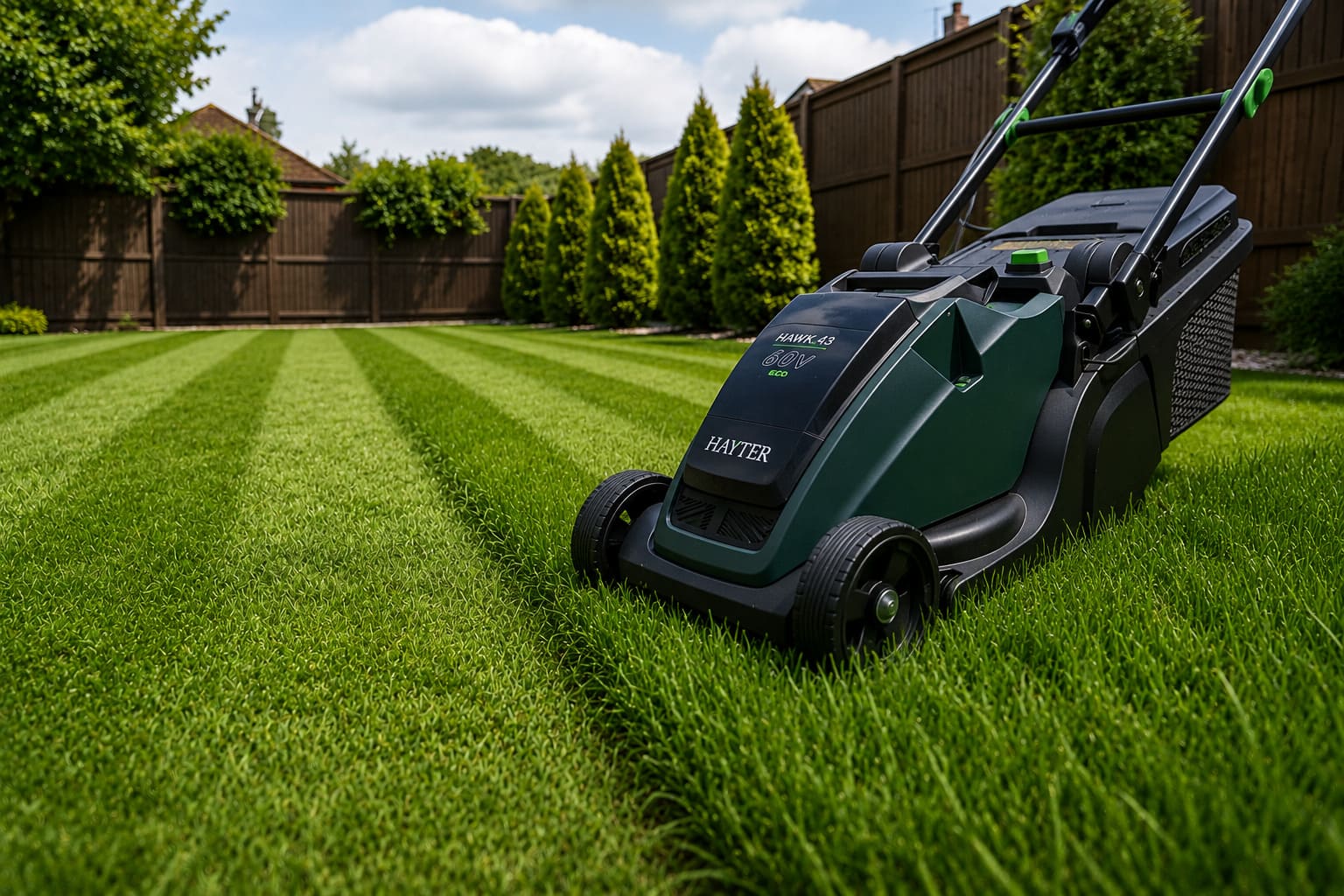
Starting with lawn mowers, the biggest question isn’t petrol vs. electric (though that matters) – it’s whether you need self-propelled or if a push mower will do. I started with a basic push mower because I thought it would give me a good workout. Three summers later, my lower back was telling a different story. Self-propelled mowers cost about £80-150 more, but if you’ve got anything more than a tiny garden, they’re worth every penny.
Here’s something nobody tells you about mower shopping: blade height adjustment matters way more than engine size. Look for a mower with easy height adjustment – preferably single-lever adjustment. I had one mower where you had to adjust each wheel individually with a spanner. It was such a pain that I rarely changed the cutting height, which meant my grass suffered during different seasons.
String trimmers (or strimmers as we call them) are where things get interesting. I went through three different strimmers my first year because I kept buying the cheaper ones. They’d work great for about two months, then start giving me problems. The issue wasn’t power – it was build quality. A decent strimmer should have a solid drive shaft, not a flexible cable. The flexible cable ones vibrate like crazy and wear out fast.
When it comes to edgers, you’ve got two main options: stick edgers and wheeled edgers. I prefer the wheeled ones for creating clean lines along driveways and pathways. They take a bit more storage space, but the results are so much more professional looking. Stick edgers are better for tight spaces and around curved flower beds.
Don’t forget about hedge trimmers if you’ve got any landscaping. Electric hedge trimmers have come a long way – they’re lighter, quieter, and don’t produce fumes. Just make sure you get one with at least a 45cm blade. Anything shorter and you’ll be there all day trimming a decent-sized hedge.
Blade maintenance is huge with all cutting equipment. Sharp blades make clean cuts that heal quickly. Dull blades tear the grass, leaving it vulnerable to disease and browning. I sharpen my mower blade twice a season – once in spring and once mid-summer. It makes a noticeable difference in how the grass looks after cutting.
Watering and Irrigation Tools for Healthy Grass
Water is life for your lawn, but here’s what I wish someone had told me from the beginning: it’s not just about how much water you give your grass – it’s about how you deliver it. I spent my first two summers dragging a cheap hose around the garden, wondering why my grass looked patchy and i was using so much water.
A quality garden hose is your foundation, but not all hoses are created equal. Those super-cheap hoses kink constantly and develop leaks within a season. I learned to invest in a hose with at least 5-ply construction. Yeah, it costs more upfront, but I’m still using the same hose I bought 10 years ago. Length matters too – measure your property and add about 7.5 metres. Nothing’s more frustrating than being just short of reaching that far corner of your garden.
Sprinkler selection is where things get really important. I started with one of those oscillating sprinklers you see everywhere. It worked okay for rectangular areas like my front lawn, but my back garden has curves and odd shapes. Impact sprinklers cover circular areas much better, and they’re built to last. I’ve got a set that’s been working for seven years straight – just needs occasional cleaning.
Here’s a game-changer that most people overlook: a water timer. These little devices attach to your outside tap and automatically turn your sprinkler on and off. I was terrible at remembering to move and turn off sprinklers, which meant some areas got too much water whilst others got neglected. A basic digital timer costs about £20 and will pay for itself in water savings within a month.
For larger properties, consider investing in a travelling sprinkler. These things look a bit goofy – they follow a hose path across your garden like a little tractor – but they’re incredibly efficient. You can set it up to water your entire lawn whilst you’re at work. Just make sure your hose path is smooth and straight.
Drought-resistant watering is something I had to learn the hard way during a particularly dry summer. Shallow, frequent watering actually makes grass weaker because the roots don’t develop deeply. Instead, water less frequently but for longer periods. This encourages deep root growth, which makes your grass more resilient during dry spells. A soil moisture meter helps you know when your grass actually needs water rather than guessing.
Don’t forget about hand watering tools either. A good adjustable nozzle for spot watering new seed or treating specific areas is essential. The trigger-style nozzles are easier on your hand during extended use than the thumb-control ones.
Soil Care and Treatment Application Tools
This is where I really messed up as a beginner – I thought lawn care was just about cutting grass and watering it. Turns out, everything starts with the soil, and you need the right tools to keep that soil healthy.
Fertiliser spreaders are probably the most important tool in this category, but choosing the right type matters enormously. I started with a handheld broadcast spreader because it was cheap and seemed simple. Big mistake. The coverage was uneven, and I ended up with dark green stripes where I’d overlapped and light patches where I’d missed. Drop spreaders give you much more control, especially if you’ve got flower beds or areas where you don’t want fertiliser.
The key with any spreader is calibration. Most people just guess at the settings, but every spreader is different. I spent an afternoon testing mine on my drive with sand to see the actual coverage pattern. Sounds nerdy, but it saved me from burning my grass with too much fertiliser and wasting money on areas that didn’t need treatment.
Lawn aerators are something most homeowners don’t think about until their grass starts looking terrible. Compacted soil is a silent killer – water and nutrients can’t penetrate, and grass roots can’t spread. I hired a powered aerator for years before finally buying a manual one. The manual aerators work fine for smaller gardens and don’t require dealing with hire shops or maintenance.
Soil testing is absolutely crucial, but you don’t need expensive lab tests for basic lawn care. A simple pH test kit will tell you if your soil is too acidic or alkaline. I discovered my soil was way too acidic, which explained why my grass never looked quite right despite all my efforts. A few applications of lime fixed the problem, but I never would have known without testing.
Scarifying tools are another category that gets overlooked. Thatch is that layer of dead grass and roots that builds up between the soil and living grass. A little thatch is good, but too much prevents water and nutrients from reaching the roots. I use a scarifying rake every spring – it’s basically a rake with sharp, curved tines that pull out the dead material. It’s hard work, but the difference in grass health is noticeable.
For seed spreading, a separate tool isn’t always necessary if you’ve already got a good broadcast spreader. But for overseeding or spot repairs, a handheld spreader gives you better precision. I keep a small one just for grass seed – it’s easier to control the application rate with small seeds.
Seasonal Cleanup and Maintenance Equipment
Autumn cleanup used to be my least favourite part of lawn care until I got the right tools. I was spending entire weekends raking leaves with a basic leaf rake, then struggling to get them into bags without creating a huge mess all over my drive.
The leaf rake vs. leaf blower debate is real, and honestly, you probably need both. Leaf rakes are better for getting leaves out of flower beds and tight spaces without damaging plants. But for open lawn areas, a good leaf blower will save you hours of work. I resisted getting a blower for years because I thought they were just noisy toys for lazy people. Man, was I wrong about that.
When shopping for leaf blowers, don’t get hung up on maximum MPH ratings. Volume of air (measured in CFM) matters more than speed for most homeowner tasks. A blower that moves 400 CFM at 150 MPH will be more effective than one that moves 200 CFM at 200 MPH. Also, variable speed controls are worth the extra cost – you don’t always need full power, especially around delicate plants.
For rakes, the tines make a huge difference. Plastic tines are lighter and won’t scratch delicate surfaces, but they’re not as effective at grabbing wet or matted leaves. Metal tines work better but can damage lawn surfaces if you’re not careful. I keep both types – plastic for most jobs, metal for stubborn cleanup.
Tarpaulins are an underrated tool for leaf cleanup. Those big square tarps with handles make it so much easier to collect and move large amounts of leaves. I used to try bagging everything directly, which meant constantly fighting with bags that wouldn’t stay open. Now I blow or rake everything onto a tarp, then drag it to wherever I need it.
Winter preparation tools are region-specific, but even in milder climates, you need some basic equipment. A good leaf rake doubles as a scarifying rake for spring cleanup. Snow removal tools obviously depend on your climate, but even a basic shovel for clearing pathways is important for lawn health – you don’t want people creating new paths across your grass because the proper ones are blocked.
Debris removal gets easier with the right containers. Those flexible garden waste bags are great because they’re reusable and stand up on their own. Rigid containers work too, but they take up more storage space when not in use.
Tool Storage and Organisation Solutions
I learned about tool storage the hard way – by having my first set of “good” tools rust out in one winter because I left them outside. Proper storage isn’t just about organisation; it’s about protecting your investment and making sure your tools are ready when you need them.
Garage storage is ideal if you’ve got the space, but not everyone does. Wall-mounted tool racks keep everything visible and accessible. Before i properly racked out my shed I used a simple plywood pegboard with hooks – it’s cheap, customisable, and makes it easy to see when something’s missing. The key is mounting it at the right height so you’re not wrestling with long-handled tools.
For outdoor storage, a good shed is worth the investment if you’re serious about lawn care. But if space or budget is limited, at least get a waterproof storage box for your hand tools and supplies. I keep my fertilisers, grass seed, in a storage boxes in my she, but you can also store one on your patio if you dont have a shed. It’s convenient and keeps everything dry.
Tool hooks and holders make a huge difference in organisation. Those cheap plastic hooks break constantly – invest in metal ones. For long-handled tools like rakes and spades, or you can use simple brackets made from PVC pipe cut lengthwise. They hold the handles securely and cost almost nothing to make.
Weather protection is crucial, especially for tools with wooden handles. Even tools stored indoors can suffer from humidity changes. I apply a light coat of oil to metal surfaces before winter storage and check wooden handles for splinters or cracks each spring. A little maintenance goes a long way toward extending tool life.
Cleaning stations are something most people don’t think about, but they’re incredibly useful. I set up a simple cleaning area next to my garden tap with a stiff brush and bucket. Cleaning tools right after use, especially after working in wet or muddy conditions, prevents buildup that can cause rust and damage.
Building Your Tool Collection on Any Budget
Here’s the truth nobody wants to tell you: you don’t need to buy everything at once, and you definitely don’t need the most expensive version of every tool. I purchased one tool at a time, made the best of what i had while i saved up for my next purchase.
I worked smart, and while saving. If something was taking me a long time I would invest in a tool that would get the job done quicker and give me a better result in the process.
Start with the absolute basics: a good spade, a rake, a quality garden hose, and whatever cutting equipment your property requires. For most homeowners, that means a decent lawn mower and maybe a strimmer. Everything else can wait until you actually need it or until you find a good deal.
Priority tools for new homeowners should focus on maintenance rather than major projects. Get the tools that will keep your existing lawn healthy before investing in renovation equipment. A spreader for fertiliser is more important than an aerator in your first year. A good sprinkler system is more valuable than expensive specialty tools you might use once a season.
The quality vs. budget decision gets easier when you think about frequency of use. Tools you’ll use weekly deserve higher investment than tools you might use twice a year. I spent good money on my mowers and spreader because I use them constantly. My scarifying rake was a also a high purchase because even though I only use it twice a year on my lawns, it will last a lifetime and its part of a multi-tool system that took me a few years to build up as the attatchments or quite expensive, but they will last me a life-time.
Seasonal buying strategies can save you serious money. End-of-season clearances are real – I’ve bought lawn care tools for 40% off in late autumn and winter. Spring is the worst time to buy lawn equipment because demand is highest. Plan ahead and shop off-season when possible.
Tool sharing with neighbours makes sense for expensive, infrequently used equipment. Aerators, pressure washers, and other specialty tools are perfect for sharing arrangements. Just make sure you establish clear agreements about maintenance and replacement if something breaks.
Hire options work well for trying out equipment before buying or for one-time projects. I hired different types of equipment before deciding which style worked best for my property. Hiring let me compare options without committing to a purchase.
Conclusion
Building the right collection of lawn care tools doesn’t happen overnight, and it doesn’t have to break your budget. The key is understanding that proper tools don’t just make your garden look better – they make the work easier, more efficient, and actually enjoyable.
Start with quality basics and build your collection as you learn what your specific property needs. Every garden is different, and what works perfectly for your neighbour might not be the best choice for you. Pay attention to which tasks you find most challenging or time-consuming, and invest in tools that address those specific issues.
Remember that tool maintenance is just as important as tool selection. The cheapest tool that’s properly maintained will serve you better than expensive equipment that’s neglected. Clean your tools after use, store them properly, and perform basic maintenance like sharpening blades and oiling moving parts.
Most importantly, don’t get overwhelmed by all the options out there. Lawn care is supposed to be satisfying, not stressful. Start simple, learn as you go, and gradually build up your toolkit based on actual experience rather than what you think you might need.
What lawn care tools have made the biggest difference in your garden maintenance routine? I’d love to hear about your favourite discoveries or biggest tool mistakes – we’ve all been there, and sharing experiences helps everyone make better choices!
Articles you may find helpful:
- The Complete Homeowner’s Guide to Lawn Care
- Lawn Mower Blade Sharpening: Essential Maintenance for UK Gardeners
- Common Lawn Diseases in the UK and How to Prevent Them
- Best Grass Types for The UK Climate
Frequently Asked Questions
What are the 5 most essential lawn care tools every homeowner needs?
The five absolute must-have tools are: a quality spade for edging and digging, a reliable lawn mower suited to your garden size, a good garden hose with adjustable nozzle for watering, a fertiliser spreader for even nutrient distribution, and a sturdy rake for debris cleanup and soil preparation. These core tools will handle 90% of your basic lawn maintenance needs, and you can build your collection from there based on your specific garden requirements.
How much should I budget for basic lawn care tools as a new homeowner?
For a starter toolkit covering the essentials, budget around £200-400. This includes a decent push mower (£150-250), basic hand tools like spade and rake (£50-80), a quality garden hose and sprinkler (£40-60), and a simple fertiliser spreader (£30-50). You don’t need to buy everything at once – start with the most critical tools for your immediate needs and add others throughout your first year as you discover what your specific garden requires.
Should I buy petrol or electric lawn care tools?
Electric tools are generally better for most homeowners today – they’re quieter, require less maintenance, start reliably, and produce no emissions. However, petrol tools still make sense for larger properties (over half an acre), areas without convenient power access, or if you need maximum power for tough conditions. Battery-powered tools offer the best of both worlds but come at a premium price. Consider your garden size, power availability, and how often you’ll use the tools when making this decision.
When is the best time to buy lawn care equipment to get the best deals?
Late autumn and winter offer the best prices on lawn care equipment, with many retailers offering 30-50% discounts on mowers, strimmers, and other seasonal tools. Avoid buying in spring when demand peaks and prices are highest. End-of-season clearances in September and October are particularly good for finding quality equipment at reduced prices. Planning ahead and shopping off-season can save you hundreds of pounds on a complete toolkit.
How do I know if I need manual or powered versions of lawn care tools?
Choose powered tools if you have a large garden (over 200 square metres), physical limitations that make manual work difficult, or time constraints that require faster completion of tasks. Manual tools work well for smaller gardens, provide better precision for detailed work, never break down, and offer good exercise. Consider your garden size, physical capability, available storage space, and budget. Many homeowners benefit from a mix – powered mower and strimmer for efficiency, but manual tools for precision work and smaller tasks.



