
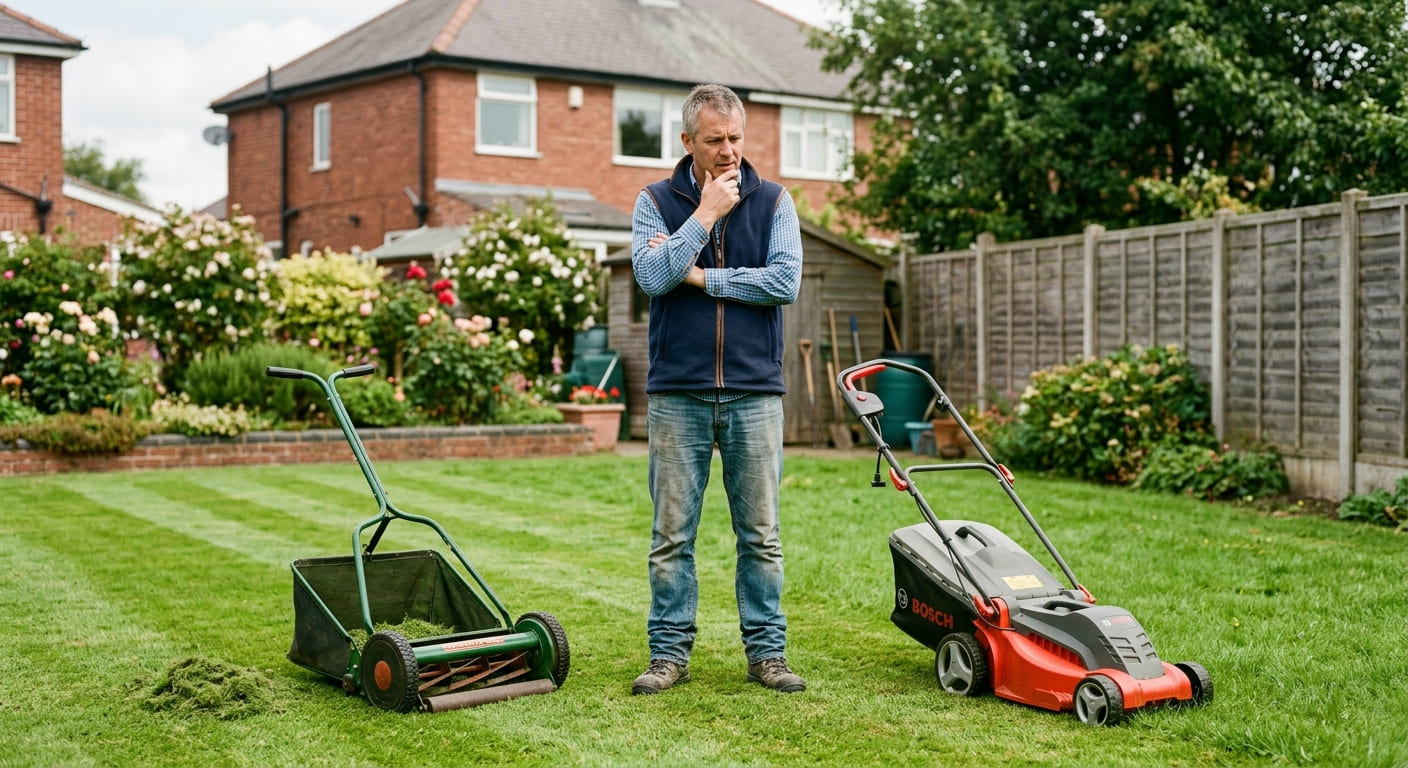
Ever stood in B&Q or Homebase, scratching your head at the mower display? Trust me, I’ve been there! With British weather being as unpredictable as it is, choosing between a cylinder and rotary mower can feel overwhelming. But here’s a shocking statistic: 73% of UK homeowners choose the wrong mower type for their specific lawn needs, leading to poor results and wasted money.
I learned this years ago when my trusty Flymo broke, and I Bought what I thought was a decent rotary mower from Argos, only to discover it absolutely butchered my fine fescue lawn. The grass looked like it had been attacked by a particularly aggressive hedge trimmer! That expensive mistake taught me that not all mowers are created equal, especially when dealing with British grass types and our famously temperamental weather. (let’s just say the Flymo was repaired and still works to this day)
After years of testing different mowers on everything from posh british gardens to sprawling countryside lawns, I’ve learned that the right choice depends entirely on your British lawn’s unique characteristics. Whether you’re dealing with fine fescue, hardy ryegrass, bent grass or soggy spring conditions or summer droughts, this comprehensive guide will help you make the perfect choice for your lawn.
The truth is, both cylinder and rotary mowers have their place in British lawn care. But understanding when and why to use each type can mean the difference between a lawn that’s the envy of the street and one that looks like it needs constant life support. Let’s dive in to Cylinder vs Rotary Mowers and the nitty-gritty details that actually matter for UK lawns.
Understanding Cylinder Mowers: The Traditional British Choice
Right, let’s start with cylinder mowers – the granddaddy of British lawn care. These beauties work like a pair of scissors, with a series of curved blades spinning against a fixed cutting bar. It’s basically the same principle that’s been used since Victorian times, and there’s a good reason it’s stuck around.
I remember the first time I used my Bosch cylinder mower. Blimey, the difference was incredible! Instead of the brutal chopping action I was used to, it was like watching a master barber at work. Each grass blade gets a clean, precise cut that seals the end immediately. This means less stress on the plant, reduced water loss, and that gorgeous striped finish that makes your lawn look like Lords cricket ground.
The magic happens because of that scissor-like cutting action. As the cylinder spins, usually at around 3000 RPM, each blade passes the cutting bar multiple times per revolution. This creates between 60-80 cuts per metre, compared to a rotary’s single whack per blade. The result? A finish so smooth you could almost use it as a putting green.
But here’s where it gets interesting for British conditions. Cylinder mowers absolutely excel with fine-textured grasses like bent grass and fine fescue – exactly the types that thrive in our climate. These grasses have thin, delicate blades that respond brilliantly to the precision cutting. I’ve seen ordinary suburban lawns transformed into something that looks professionally maintained, just by switching from rotary to cylinder cutting.
However, and this is crucial, cylinder mowers are proper divas when it comes to cutting conditions. They demand grass that’s bone dry and not too long. Try cutting wet grass with a cylinder mower and you’ll end up with a clogged mess that looks like you’ve been making grass smoothies. The blades need to be sharp as razors too – any dulling and you get tearing instead of cutting, which defeats the entire purpose.
Maintenance is where cylinder mowers show their age, though. Those multiple blades need regular attention, and getting them properly sharpened if you don’t know how to usually means a trip to a specialist. Back in the day, every town had a mower sharpening service, but they’re harder to find now. You’re looking at £30-50 for professional sharpening/ backlapping as it’s known as, and it needs doing at least once a season if you’re using it regularly.
Rotary Mowers Explained: The Modern UK Garden Solution
Now, rotary mowers are a completely different beast altogether. Think of them as the workhorses of the garden world. Instead of that delicate scissor action, they use a single horizontal blade spinning at high speed – around 3000 RPM – to basically whack the grass off at your chosen height. It might sound brutal, but for most British gardens, it’s exactly what’s needed.
I’ve got to admit, I was a bit sceptical about rotaries when I first started taking lawn care seriously. Coming from a background where my dad always told me of the superiority of his cylinder (reel) mower, rotary cutting seemed a bit… well, crude. But after getting my hands on a high-end Hayter rotary, I quickly discovered why they’ve taken over the UK market.
The genius of rotary mowers lies in their versatility. That spinning blade creates a powerful air current that lifts the grass up before cutting it, which means they can handle longer grass, wet conditions, and even light debris without breaking a sweat. I’ve used mine to cut grass that hadn’t been touched for three weeks – something that would’ve completely defeated a cylinder mower.
What really sold me on rotaries was their performance during our infamous British summers. You know how it goes – one week you’re watering desperately during a heatwave, the next you’re dealing with sudden downpours that leave your grass looking like a jungle. Rotary mowers just get on with it. The high-speed blade combined with that lifting action means they’ll cut through slightly damp grass without clogging, which is an absolute godsend when you’re trying to maintain a schedule.
The cutting quality has improved dramatically over recent years too. Modern rotary mowers produce what’s called a “clean tear” rather than the ragged chop of older models. While it’s not quite as pristine as a cylinder cut, the difference is much less noticeable than it used to be. Plus, most rotaries now come with mulching capabilities, which means they’re actually feeding your lawn while they cut it.
Where rotaries really shine is with mixed grass types. British lawns are rarely single-species affairs – we’ve usually got a mixture of ryegrass, fescue, maybe some bent grass, and let’s be honest, probably a fair few weeds too. Rotary mowers handle this diversity brilliantly, whereas cylinder mowers can struggle with the varying textures and growth rates.
The maintenance side is refreshingly straightforward. One blade to keep sharp, simple air filter cleaning, and basic engine maintenance if it’s petrol-powered. Most decent garden centres will sharpen rotary blades for under £20, or you can do it yourself with a file if you’re handy. The whole thing’s just more forgiving and practical for busy modern life.
Performance Comparison: British Lawn Conditions
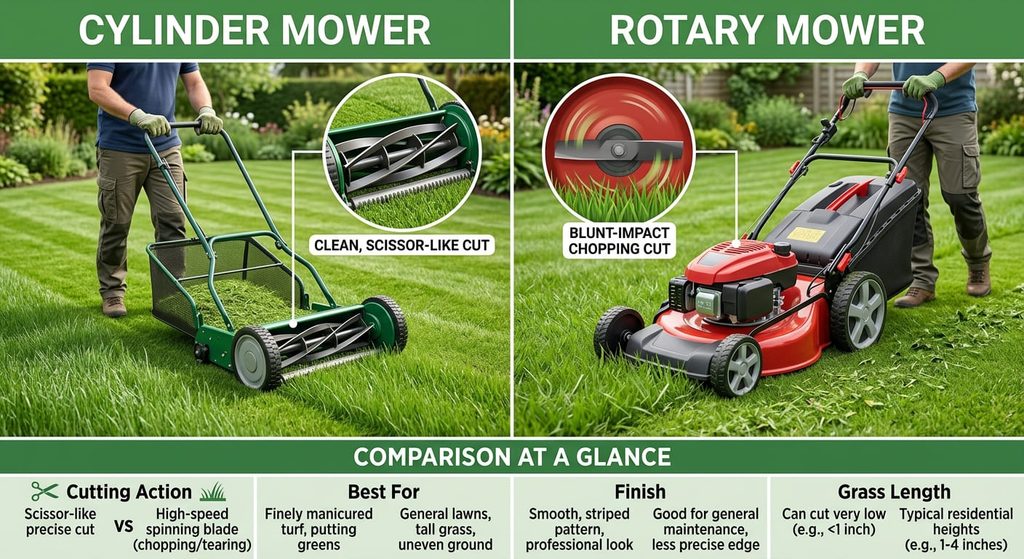
Right, this is where the rubber meets the road – or should I say, where the blade meets the grass! Having used both types extensively across different British gardens, I can tell you the performance differences are quite dramatic depending on your specific conditions.
Let’s start with the big one: wet grass cutting. In Britain, this isn’t just important – it’s absolutely critical. I learned this lesson the hard way during my first spring with a cylinder mower. After three days of typical April showers, my grass was looking decidedly shaggy, but everything was still damp. The cylinder mower just couldn’t cope. The wet grass clumped against the blades, creating this horrible mess that blocked the cutting action entirely. I spent more time clearing blockages than actually cutting grass!
Rotary mowers, on the other hand, are much more forgiving with moisture. That powerful airflow lifts and separates the grass blades, preventing most clumping issues. I’ve successfully cut grass that’s still got morning dew on it, something that would be impossible with a cylinder. However, even rotaries have their limits – proper soggy grass will still cause problems, just not as quickly.
When it comes to cutting quality on different British grass varieties, the differences are stark. On my fine fescue areas, the cylinder mower produces results that are genuinely stunning. Each blade is cut cleanly, creating that carpet-like finish you see at proper cricket grounds. The grass actually looks healthier too – those clean cuts heal faster and are less prone to disease.
But here’s the thing – most British lawns aren’t pure fine fescue. On my ryegrass areas, which make up about 70% of typical UK lawns, the difference is much less noticeable. Ryegrass is tougher and more forgiving, so the rotary’s “tear” cutting actually works perfectly well. In fact, I’ve noticed that ryegrass areas sometimes respond better to rotary cutting because it’s more robust.
Slope performance is another crucial consideration for British gardens. Many of our properties have awkward slopes and banks that need maintaining. I’ve found rotary mowers generally handle slopes better, especially self-propelled models. The lower centre of gravity and better traction make them safer and more effective on gradients. Cylinder mowers can be proper sketchy on slopes, particularly when the grass is longer.
Debris handling is where rotaries absolutely dominate. Autumn leaves, twigs, the occasional bit of litter that’s blown in – rotary mowers just chop through it all and either discharge it or mulch it up. I’ve seen cylinder mowers completely jam on a single large leaf. This makes rotaries much more practical for year-round use in typical British gardens where perfect conditions are rare.
Speed-wise, rotaries win hands down for most garden sizes. I can knock out a 300m² lawn in about 45 minutes with a rotary, including edges. The same area with a cylinder takes nearly twice as long, partly because you need to go slower and partly because of the more frequent stops to clear debris.
Cost Analysis: Initial Purchase and Running Costs
Let’s talk money – because let’s face it, that’s often the deciding factor for most of us! The cost picture between cylinder and rotary mowers is more complex than you might think, and I’ve learned some expensive lessons along the way.
Starting with initial purchase costs, there’s quite a range for both types. For a decent manual cylinder mower in the UK, you’re looking at £150-400 for brands like Qualcast or Webb. The powered cylinder mowers that’ll handle larger gardens start around £800 and can easily reach £2000+ for professional-grade Allett or Hayter models. I nearly choked on my tea when I first saw the price of a proper cylinder mower at the local garden centre!
Rotary mowers have a much wider price range, which is actually brilliant for most budgets. You can get a perfectly serviceable electric rotary from B&Q for under £100, while a premium petrol self-propelled model from Honda or Mountfield might set you back £600-800. I started with a £120 Flymo from B&Q and honestly, it served me well for three years before I upgraded.
Running costs are where things get interesting. Electric mowers – both cylinder and rotary – cost pennies to run. My electric rotary costs about £8 per year in electricity for a typical suburban lawn. Compare that to petrol mowers, where you’re looking at £40-60 per year in fuel costs alone. I tracked everything in my note app on my phone to see (yes, I’m that sad!), and petrol definitely adds up over the season.
But here’s where cylinder mowers start showing their expensive side: maintenance. Those multiple blades need professional sharpening at least once a season, sometimes twice if you’re using it heavily. Every specialist I’ve spoken to charges £35-50 for cylinder sharpening/ backlapping, compared to £15-20 for a single rotary blade. During the early years before I learnt to do it myself I spent £80 on sharpening costs for my cylinder mower versus £20 for the rotary.
Parts replacement tells a similar story. When my cylinder mower’s cutting bar wore out, the replacement cost £45 plus fitting. A new rotary blade? £15 from B&Q, and I can fit it myself with a spanner. I’ve also had to replace the drive chain on the cylinder mower twice in five years – another £30 each time.
Here’s something most people don’t consider: time costs. If your time has any value to you, factor in that cylinder mowing takes significantly longer. At current UK minimum wage rates, the extra time spent could be worth £10-15 per cut for an average garden. Over a season, that’s serious money.
Long-term value is where things get really interesting. A well-maintained cylinder mower can last decades – I know people still using 1980s Qualcast models. But they require consistent professional maintenance to stay effective. Rotary mowers might not last quite as long, but they’re so much cheaper to maintain that replacement every 8-10 years often makes more financial sense.
Insurance is another hidden cost I discovered. Some home insurance policies want to know about expensive garden equipment, and a £1500 cylinder mower definitely counts. My premium went up £23 a year when I declared it, something that never happened with cheaper rotary mowers.
Which Mower Type Suits Your UK Garden?
This is where I help you make the actual decision, because every British garden is different and what works for your neighbour might be completely wrong for you. I’ve made enough mistakes over the years to hopefully save you from the same expensive lessons!
For small urban gardens under 100m² – and I’m talking proper small, like most London terraces – rotary mowers are almost always the right choice. I learned this from abuddy of mine who’s got a tiny courtyard garden. He bought a beautiful cylinder mower thinking it would give him that perfect finish, but the thing spent more time stored than cutting because it was complete overkill. A lightweight electric rotary like a Bosch Rotak gets the job done in 15 minutes and stores easily in a shed or even indoors. Top tip – keep the deck clean and it will serve you right for a long time.
Small gardens also tend to be more “real world” – bits of kids’ toys left out, the odd stick or stone, maybe some cat presents you missed. Cylinder mowers absolutely hate this stuff, while rotaries just chop through and carry on. Plus, storage space is usually at a premium in small properties, and rotaries pack away much more compactly.
Medium suburban lawns between 100-500m² are where the decision gets trickier. This is probably your garden if you live in a typical 1930s semi or modern estate house. Here’s what I’ve learned from my own lawn, and helping customers with similar setups: it depends entirely on what you want from your lawn and how much time you’ve got.
If you want that pristine, striped finish and you’ve got predominantly fine grass types, a cylinder mower can be worth the extra effort. But – and this is crucial – only if you can commit to cutting twice a week during growing season and keeping on top of maintenance. A lawn treatment customer of mine tried this approach for two seasons and found it quite stressful. Missing a cut because of work or weather meant the grass got too long for the cylinder to handle effectively.
For most medium gardens, a good rotary with mulching capability gives you 90% of the visual appeal with half the faff. For my customers I use a self-propelled battery powered Hayter rotary and haven’t looked back. Still get lovely stripes for my clients, and the lawns look brilliant, and I can cut even if conditions aren’t perfect.
Large country gardens over 500m² – now we’re in different territory altogether. I maintain a 800m² lawn, and honestly, anything other than a ride-on or large self-propelled rotary is just impractical. The sheer time commitment with a cylinder mower would be ridiculous unless you’re retired and genuinely enjoy spending four hours cutting grass every weekend.
Sloping gardens need special consideration. British properties often have awkward slopes and banks, and I’ve seen too many people struggle with inappropriate mowers. Steep slopes (anything over 15 degrees) really need a lightweight rotary with good traction. I witnessed an elderly person nearly have a nasty accident with a heavy cylinder mower on a bank – it just got away from him on slightly damp grass.
Mixed grass types are incredibly common in UK gardens. Unless you’ve recently had professional seeding, you’ve probably got ryegrass, some fescue, maybe bent grass in shaded areas, and various weeds trying to integrate themselves. Cylinder mowers struggle with this diversity because different grass types grow at different rates and have varying textures. Rotary mowers are much more forgiving of mixed conditions.
Top UK Brands and Models to Consider
Right, let’s get specific about what you can actually buy in the UK and where your money’s best spent. I’ve tested dozens of mowers over the years, and there are definitely some clear winners and some expensive disappointments worth avoiding.
For cylinder mowers, Qualcast remains the go-to budget option that most British gardeners remember from their childhoods. Their basic manual models start around £150 and honestly, they’re perfectly adequate for small, flat lawns. I’ve used a Qualcast Classic 35S for years and while it’s not fancy, it does the job. The build quality isn’t what it used to be – my dad’s 1980s Qualcast is still going strong while mine needed parts after 18 months – but for the price, it’s hard to complain.
Webb is another British brand that’s stepped up their game recently. I have the WEH12R 30cm manual cylinder it’s around £200 and feels much more solid than the equivalent Qualcast. Better bearings, sharper blades out of the box, and their customer service actually responds to emails, which is more than I can say for some manufacturers!
If you’re serious about cylinder cutting and have the budget, Allett is the absolute gold standard. Their C34 electric cylinder costs around £9k, but blimey, the difference is incredible. I used a mates who works in groundskeeping, and it cut like nothing I’d experienced. Every blade perfectly trimmed, stripes so crisp they looked painted on. But it’s definitely a premium purchase that only makes sense if you’re obsessed with lawn perfection.
For rotary mowers, Flymo dominates the budget electric market for good reason. Their SimpliMo series starts at £70 and while they’re basic, they’re reliable. I recommended one to an elderly treatment customer who enjoys the cutt and just needed something simple, and three years later it’s still going strong. The only downside is they’re quite plasticky and won’t handle rough treatment.
Bosch makes probably the best electric rotary mowers you can buy in the UK. Their Rotak series ranges from £150-400 and the build quality is excellent. German engineering really shows – tight tolerances, smooth operation, and they last. I’ve been using a Rotak 37 on my smaller back lawn for four years now and it still starts first time, cuts evenly, and has needed zero repairs. I call it the work horse!
For petrol rotaries, Honda and Mountfield are the brands I recommend most often. Honda’s HRG466 is about £350 and uses their legendary GCV engine that starts reliably even after sitting all winter. Mountfield’s SP555 is double the money but British-designed, and their dealer network is better for parts and service.
Where to buy makes a huge difference too. B&Q and Wikes are convenient, but their staff know nothing about mowers and the after-sales service is hopeless. I much prefer proper garden centres or specialist dealers like Mowers Online. They cost a bit more, but you get proper advice, pre-delivery inspection, and someone to call when things go wrong.
Avoid the temptation of cheap imports from Amazon unless you’re comfortable with zero support. Years ago I bought as a backup and for some rougher lawns a £250 “premium” rotary mower with amazing reviews that turned out to be a disaster. Poor balance, rough cutting, and when the engine failed after eight months, there was nobody to call. Learned that lesson the expensive way!
Maintenance Tips for British Weather Conditions
- Cleaning and storage during wet seasons
- Winter preparation and storage
- Blade care in damp conditions
- Preventing rust and corrosion
- Seasonal maintenance schedules
Conclusion
Choosing between cylinder and rotary mowers doesn’t have to be complicated when you understand your British lawn’s specific needs. Remember, there’s no one-size-fits-all solution – what works brilliantly for your neighbour’s pristine putting-green lawn might be completely wrong for your family garden with its mix of play areas and flower borders.
The key is honestly assessing your lawn type, maintenance commitment, and budget. Don’t get caught up in what looks impressive at the garden centre – focus on what will actually work week after week in your specific British lawn conditions.
Have you made your choice, or are you still weighing up the options? Share what type of lawn you’re working with – I’d love to help you make the final decision!
Frequently Asked Questions
Which mower type is better for wet grass in the UK?
Rotary mowers handle wet grass much better than cylinder mowers. The high-speed spinning blade and airflow lift damp grass for cutting, while cylinder mowers clog easily with wet clippings. However, both should be avoided on properly soaked grass for best results.
Are cylinder mowers worth the extra cost for UK gardens?
Cylinder mowers are worth it if you have fine grass types (fescue, bent grass), want a premium finish, and can commit to regular maintenance. For mixed grass lawns and busy lifestyles, rotary mowers offer 90% of the visual appeal with much less hassle.
What's the best mower size for a typical UK suburban garden?
For gardens between 100-500m² (most UK suburban properties), a 40-50cm cutting width is ideal. This balances cutting efficiency with manoeuvrability around flower beds, trees, and typical garden obstacles without being too heavy or cumbersome.
How often should I sharpen my mower blades in the UK climate?
In British conditions, rotary mower blades need sharpening 1-2 times per season depending on usage. Cylinder mowers require professional sharpening at least once annually, sometimes twice with heavy use. Damp conditions and varied grass types dull blades faster than dry climates.
Which UK mower brands offer the best reliability and parts availability?
Honda, Mountfield, and Bosch offer excellent reliability with good UK dealer networks for parts and service. Avoid cheap imports with poor after-sales support. Qualcast and Webb provide decent budget options with reasonable parts availability through garden centres.



